Three 20-something women trying to figure out what it means to be lay, Catholic, and modern all at once.


Showing posts with label life in the church. Show all posts

September 21, 2010

Bravissimo NY Times

I am just now catching up on reading all about Pope Benedict's trip to the UK last week. Given that I did lots of running around and my media sources were limited to NPR snippets about protests and sex scandals, I was relieved to read what the man himself had to say. I particularly felt the beauty of this quote, from a speech he gave during his homily in Glasgow's Bellahouston Park:
There is only one thing which lasts: the love of Jesus Christ personally for each one of you. Search for him, know him and love him, and he will set you free from slavery to the glittering but superficial existence frequently proposed by today’s society. Put aside what is worthless and learn of your own dignity as children of God.
Thank God for the Holy Father to remind of us that....because the world is weary indeed.

I also appreciated this Op-Ed from (shocker!) that bastion of left-wing liberalism, the New York Times. Columnist Ross Douthat had this today regarding protests to the Papal visit:
And yes, the church’s exclusive theological claims and stringent moral message don’t go over well in a multicultural, sexually liberated society. But the example of Catholicism’s rivals suggests that the church might well be much worse off if it had simply refashioned itself to fit the prevailing values of the age. That’s what the denominations of mainline Protestantism have done, across the last four decades — and instead of gaining members, they’ve dwindled into irrelevance.... This, above all, is why the crowds cheered for the pope, in Edinburgh and London and Birmingham — because almost five centuries after the Catholic faith was apparently strangled in Britain, their church is still alive.
Bravissimo, NYT. Now I know why, despite your manifold faults, I continue to read you.

April 26, 2010

Women and the Church


True to my promise in a post from couple weeks ago AND in reply to our commentator Anthony from my What Would Mary Do? post, I want to revisit the theme of femininity and masculinity particularly as they pertain to roles in the Church.

First let me propose Anthony's challenge to me in the aforementioned post:
So if I am reading this correctly, you are saying that women are NOT equal to men and are not WORTHY to lead the lay people in their faith in the way that men are?? You mention that feminists would be opposed to what Lisa Miller said, but I'm pretty darn sure Miller herself is a feminist, and I can't think of a single feminist who in her right mind wouldn't agree with Miller.
Can I just say, Thank you, Anthony for bringing up this intriguing critique. You beg the burning question: Are men and women equal? Are the equally worthy to lead the Church? To at least that first question, I would emphatically answer YES, men and women are indeed equal in dignity before the Lord and very much equally human. I think that second part of the question is where I, and perhaps other women who are feminists of my thinking might have some issues. Let me explain.

Last year, Julian wrote a post summarizing a common interpretation of the feminist movement that posits four distinct waves of feminist thought. I won't go into too much detail about them here, but I will say that with few exceptions, I can say that the first two waves of feminism promoting women's suffrage, property rights, and equal protection under the law, are entirely acceptable to me. The problem is with that messy 'third wave,' which took a rather radical turn and, as far as I can tell, is internally contradicting itself. This third wave of feminism claims men and women are equal - equal rights for equal pay. Yes, I am on board there, of course, as long as equal work is really being done. But, then it goes on - Equal everything, women are just like men, we can do all things men can do without exception, etc. And yes, the abortion rights - absolute control of sexuality, birth control, sexual liberation, the "right" to have sex like a man - etc.

Here is where I find myself scratching my head and bewildered. Men and women are of course equal in many ways, but they are well...different, aren't they? So, should they be forced to do all things the way men do them? Well, you can think of some scenarios where that is probably not optimal. For example, friends in the military have told me that when a woman gets shot in military duty, it lowers morale of the troops significantly more than when a man gets shot. While that is anecdotal evidence, I think can we understand that, right. There's just something different about a woman being wounded than a man. In terms of sexuality - is a woman capable of 'having sex like a man' (Carrie Bradshaw's opening question in the Sex and the City series) or of being 'sexually liberated?' What does that really mean? Well, we can look at the fruits of it: increase in STD's,increase in divorces and unfaithful marriages, increase in teenage pregnancies, increase in abortion, low birth rates, etc. That does not seem to be liberating to either men or women, it seems to have merely enslaved us all our sexual appetites. I'd love to hear some other perspectives on my assertions here.

Now, what about women in the Church? After all, that is what Lisa Miller was writing about in her Newsweek article. Why should not women be priests? After all, I have asserted that we are equal in dignity before the Lord and equal before the law. Why shouldn't they be equally allowed to be priests (or priestesses). Here, I'd like to refer to my beloved namesake, Edith Stein, from her Essays on Woman. Regarding priesthood for women, she writes:
If we consider the attitude of the Lord Himself, we understand that He accepted the free loving services of women for Himself and His Apostles and that women were among His disciples and most intimate confidants. Yet He did not grant them the priesthood, not even to His mother, Queen of Apostles, who was exalted above all humanity in human perfection and fullness of grace.... It seems to me that such an implementation [of women priesthood] by the Church, until now unheard of, cannot be forbidden by dogma.

However...the whole tradition speaks against it from the beginning. But even more significant in my opinion is the mysterious fact emphasized earlier-that Christ came as the Son of Man.... Yet He bound Himself so intimately to one woman as to no other on earth; He formed her so closely after His own image as no other human being before or after; He gave her a place in the Church for all eternity as has been given to no other human being. And just so, He has called women in all times to the most intimate union with Him: they are to be emissaries of His love, proclaimers of His will to kings and popes, and forerunners of His Kingdom in the hearts of men. To be the Spouse of Christ is the most sublime vocation which has been given, and who ever sees this way open before her will yearn for no other way. pp. 83-84
I hope, commentator Anthony, this begins to explain my position in the previous post on feminism.

To explain a man's view, I found this article from Inside Catholic particularly poignant. I'll give you a taste and hope you'll read the whole article (and I might write more on this later because I find it fascinating.)
The author asserts,
We may yet have a male-only clergy and hierarchy, but where the rubber meets the road -- in those mundane areas of church life where laity and institution most commonly interact -- the flavor is feminine. Whether you want to speak in terms of liturgy, ministry (lay and clerical), religious education, or sheer congregational numbers, official ecclesial power may not rest in the hands of women, but considerable unofficial influence clearly does, and has for some time. And we in the Church have been subject to its effects.

Not all these effects, as we shall see, have been bad. But one of the worst has been a subjugation of traditional masculine virtue: the concept of distinctly and properly manly Catholicism repressed, stigmatized, covered up, or otherwise forgotten for lack of practice. And the more "feminized" Catholicism thus became -- the more its pews became recognized as the province of wives, children, and the effete -- the more likely were men and their post-pubescent sons to stay away. All of this is making today's Church, according to Leon Podles, author of The Church Impotent, "essentially a women's club with some male officers."
The author brings up a point not often meditated upon: overly-feminized leadership in the Church keeps the men away from it. Sometimes we women can be so indignant about what we perceive to be grievances against femininity, that we forget that what we do as women, and especially as women within the Body of Christ, has a profound effect on men.

Photo found here.

April 3, 2010

Not on My Terms

Yesterday Agatha and I went to an absolutely beautiful Good Friday service at the Dominican House of Studies with the order of priests whom we both have a fondness for. Since they are the Order of Preachers, I expected a great homily, and boy, was it delivered. The homilist reflected on the fact that we might be experiencing a variety of emotions on Good Friday -- some of us pity, some of us sorrow, some of us confusion. However, he also noted that some of us might not be experiencing anything -- and that was okay. Christ does not want our emotions, the priest insisted. He wants something in our being, down to our very substance, that surpasses the accidents that may accompany it. When we were to kiss the crucifix, the priest indicated that we should give Christ our faith, hope, and charity. The theological virtues will keep us centered even when our emotions do not.

According to the priest, the centurion at the cross shows us how to live with faith, and the good thief shows us how to live with hope. But it is the mother of the Lord who shows us how to live the virtue of love, or charity, which is a love that, according to the priest, asks us to love God "not on our terms, but on His terms." Mary would have naturally wanted to take Christ down from the cross and spare him His agony. But Christ asks her to put aside her natural desires and to take John (and therefore us) as her own. Not on Mary's terms, but on the Lord's.

Now that we have arrived at Holy Saturday, I pray that we can live our vocations with love on God's terms. The Magdalene Sisters are single women in the world. We may not know why this is our vocation now, but it is. Sisters, let us respond to God with the aspiration, "Let me not love you on my terms, but on yours, Lord."

March 24, 2010

Pope's Letter to Ireland

Have you read the Holy Father's letter, released Saturday, to the Church in Ireland? You should. It is amazing. And new. And bold. And personal. And healing.

(Pope Benedict needs a lot of prayers, by the way. This is a hard time for the Church, but thank God he is our Head.)

March 16, 2010

Healing in His Way

Just a little update. Life has been well, better. The pain is still very much a part of day to day life, but I am allowing God in to heal me. I have just started attending a university branch of a group called Communion and Liberation. Have you ever heard of this movement? It is an ecclesial movement within the Church started by Father Luigi Guissani in Milan. He began this movement with a group of young people in Milan. The name 'Communion' and 'Liberation' signifies what they believe about Christian life -- only communion with the One, True God gives authentic liberation to the human person. This very much appealed to me, as I have just left a situation where I had no freedom. True love, true communion is always liberating and encourages us to become the best of ourselves, to become the person God ordained us to be.

The charism that marks the group I can only describe as making the event of the Incarnation truly known in the world - revealing Christ by their everyday witness. Communion and Liberation members do this in a special way every Good Friday by praying the Way of the Cross in major cities throughout the world (e.g. Chicago). It is a witness of carrying the Cross in a place that can be so impersonal, so inhumane, so full of human suffering. You can read more about it here. I expect great graces to come! Thanks for your prayers, and be sure I am offering mine for you!

November 5, 2009

Dowd + Dolan + Maine + Sullivan + Fawkes + the Traditional Anglican Communion + Augustine

I was planning on writing something incredibly profound and lucid about Maureen Dowd's October 25th column--but it still has me so angry, I have a hard time thinking clearly. It is filled with so many gross inaccuracies, let alone hateful hyperbole, that I am not sure how she still has her job.

Instead, I'll quote New York City Archbishop Timothy Dolan's blogged response (the times refused to print it):
In a diatribe that rightly never would have passed muster with the editors had it so criticized an Islamic, Jewish, or African-American religious issue, she digs deep into the nativist handbook to use every anti-Catholic caricature possible, from the Inquisition to the Holocaust, condoms, obsession with sex, pedophile priests, and oppression of women, all the while slashing Pope Benedict XVI for his shoes, his forced conscription -- along with every other German teenage boy -- into the German army, his outreach to former Catholics, and his recent welcome to Anglicans.

True enough, the matter that triggered her spasm -- the current visitation of women religious by Vatican representatives -- is well-worth discussing, and hardly exempt from legitimate questioning. But her prejudice, while maybe appropriate for the Know-Nothing newspaper of the 1850’s, the Menace, has no place in a major publication today. (HT)

Also excellent was the response of Michael Sean Winters at America Magazine. Winters is a perplexing but compelling character, and I am always challenged by his articles, though I often disagree. I'm in complete agreement this time, as he said:
Ms. Dowd suffers from the misperception that the Church has said it won’t ordain women. That would indeed be an objectionable claim, and one with a prima facie suspicion of misogyny. But, the Church does not say it won’t ordain women; it says it can’t ordain women. The idea that something can’t be done is foreign to liberated, early twenty-first century Americans. Our politicians, of both parties, invoke the American Dream and advertisements tell us that we can be whatever we want. Horatio Alger lives. But, the Church believes that it received a definitive revelation to which we must always be faithful. In this sense, the Church is always conservative, conserving the deposit of faith. That faithfulness requires that we do certain things and not do certain other things. The sociological argument that feminism has changed women’s experience in other fields has absolutely no bearing on the issue but Dowd couldn’t find a theological argument if her life depended upon it.


Meanwhile, with Maine voting against a gay marriage amendment, by a pretty significant margin, Thomas Peters, has done an excellent round-up on the all the anti-Catholic rhetoric surrounding this decision. He points, especially to Andrew Sullivan, the gay-catholic blogger for The Atlantic Monthly, who said:
It is time to acknowledge that the Catholic church hierarchy can no longer pretend that it isn't the active enemy of gay people and our families. That this church hierarchy - especially in its more conservative wing - is disproportionately gay itself and waging war against their fellow gays through the cowardly veil of the closet, is not new.
Sullivan goes on to quote in full a letter to a parish priest by a gay man who is "finished":
Hatred fueled by the resources of hundreds of thousands of parishes will be the central reason why the Church will eventually wither and die. I can no longer bear the stench of the rotting body and hierarchical ignorance. I can no longer embrace what has become a menace and money machine to support evil. We are all tainted by what happened in Maine. We are all lesser citizens because our brothers and sisters are lesser citizens.
Did you notice? In the entire letter, there isn't a single thought about Christ, nor about his radical love for every human being--a love that demands us to do well and live well, and set aside sin. The mass is not a gathering place, the chalice is not merely " shared by everyone"--it come with a price of our own.

I can't help but think about the timeliness of this, with regards to our Magdalene Novena: Magdalene was labeled a prostitute by all, but she shed that label and lived rightly by Christ's law, for his love. His love demanded that of her, and she saw the true cost with her own eyes.

Peters responds to this anti-catholic bigotry head on:
All this is especially ironic when one considers how the gay marriage movement tries to cast itself as one that is seeking tolerance and acceptance of all. Well, apparently the Catholic Church isn't a legitimate recipient of such treatment. I would be more encouraged if leaders of the gay marriage movement would call out or apologize for outbursts against the Church like the ones I've cited above.


Today is the 5th of November (remember, remember). Four-hundred and five years ago the Gunpowder Plot to blow up the Houses of Parliament was discovered, and squashed, as Guy Fawkes was arrested after hiding cases of gunpowder in the cellars. As William Newton points out, those were dark times for Catholics in England. But Fawkes' plot did more harm than good (as violence always does) for the cause of Catholicism in England. Though persecutions had largely died down, it was only in 1829 with the Catholic Relief Act, do we start to see some progress, and restoration of civil liberties. Guy Fawkes Night is still a night of drunken debauchery and anti-catholic demonstrations.

But, there is hope yet for the Church of England and the cause of Catholicism in England. That hope is one step closer to being realized, as the Traditional Anglican Communion officially stated that it will accept Pope Benedict's offer and seek to join the Roman Catholic Church.

Two steps forward and one step back. Anti-Catholicism will always be with us, but we needn't worry. The thing Dowd, and Sullivan, and the anonymous gay parishioner don't realize is that, though members of the church are indeed fallen, and make mistakes all the time, the Chruch itself is faithful to Christ, and will not fall. There are bigots in the Church. But the Church is not bigoted. As Winters said above: it's not that we don't, it's that we can't. By law. God's law. The God who came down from heaven, emptied himself, died on the cross, and raised us all up because he loves us.

All are indeed welcome. But that doesn't mean it's a free pass. "Love" St. Augustine says, "And do what you will."

September 1, 2009

Woman Warrior of the Month: St. Monica Part 1


Today we are each writing a post in honor of September's Woman Warrior: St. Monica, whose feast day was August 27th. This woman and sister in Christ is so incredible that she really could be every month's nominee. I could go on and on about her, but I will just tell you a little of why she is so important of a model to me.

We are taught by our Church that the pinnacle of femininity is reached in motherhood, that the "crown of a marriage" lies in children, or the visible fruits of the love between a man and a woman. I tend to stay in the shallow end of the teaching and focus on the procreative part of the feminine vocation and the married vocation...stopping at the conception and birth of children as if that is the fullness the Church is speaking of.

St. Monica's fruit was St. Augustine, but not Augustine as an infant. The fruit of her femininity was the same fruit of her labors of prayer, fasting, and modeling the faith - it was Augustine the man, the scholar, the preacher, the convert, and the saint. St. Monica is the exemplar of receiving the task that God has given you and laboring until you have made it worthy enough to glorify Him. How often do I do a mediocre job on things that are in front of me? How often do I fail to really work at my vocation of singleness? Will I accept a satisfactory job this school year as I prepare to teach young high school women, or will I pray, study, and fast so that their souls are opened to the Lord?

Thank you St. Monica, for your beautiful example.

And as a sidenote, thanks for teaching me that it's okay to love wine...just in moderation.

(Picture found here)

July 13, 2009

Humble Hope


“To God who has so abundantly blessed the church through the Dominican Order; may the Order of Preachers, under the mantle of the Mother of God, continue to flourish in fraternal love purified in obedience to the truth.”
--Archbishop Joseph Augustine Di Noia, O.P.


(HT: Whispers)

July 4, 2009

Travels

Well, I've been skipping around the country the last two weeks, and I'm finally able to sit and post.  I had a wonderful week rebuilding homes with teenagers through an amazing program run through my diocese.  It was seriously such an inspiring week, being among the less fortunate with teenagers who really have their heads and hearts fixed on Christ.  I was originally angered by the poverty that I encountered, and while I'm still uneasy about it, the time we spent talking to our resident and his granddaughter took away my anger and helped me to connect with two individuals who had the same questions about life that I had.  I have a real sense of a human family right now, and as cheesy as that sounds, in the week that followed, I found myself becoming aware of the need to really talk with people, to look them in the eye, and to hear their stories.  I pray this attitude continues for a lifetime.  It's so much easier to see Christ during the day if we slow down and talk to Him in the people we are often too busy to meet. 

The conference I went to at Notre Dame was okay in itself.  I found myself a little frustrated at other educators who were disgruntled at younger colleagues (like myself) who had different concerns than they did about the Church, insofar as someone my age would be considered a "post-Vatican II" Catholic educator.  But differences and motivations aside, we all sat listening to two pretty amazing speakers: Sr. Helen Prejean, who's life story was the backstory of the movie Dead Man Walking, and Imaculee Ilibagiza, who we've mentioned numerous times here on the blog.  And the greatest blessing of all?  I got to meet Imaculee!!! I truly believe that I was standing in the presence of a saint.  Her story of the power of the rosary, the power of forgiveness, the people of Rwanda, and the very real human fear of facing death moved me beyond words.  When she was speaking, the song "Gentle Woman" kept playing over and over in my head.  I can't wait to read more about Our Lady of Kibeho.  While Imaculee is still speaking about her experience during the genocide, she feels truly called to spread the message about Our Lady who appeared in Rwanda before the genocide.  All in all, I have been blessed with ample opportunity for God to profoundly remind me that this whole faith thing, this whole Catholic thing, is real.   

May 21, 2009

For Those of Us Who Love the Pope...

I saw this and I had to share. Presenting Pope2you.net: the Pope on just about every possible media available (although surprisingly, Pope Benedict XVI is NOT on Twitter, at least not yet...and I hope you can pick up my sarcasm on that...). I love the Pope, but I don't know whether to be excited because this is so cool, or to be totally freaked out by our reliance on technology and the FIVE different media present here!! In any event, I'll be checking it out, and I thought some of you might be interested too!!

May 9, 2009

"All the Single Ladies..."


"...Now put your hands up!" You know the song. It is always in my head!! Every one of us is waiting for that perfect moment -- when he 'puts a ring on it' and we pledge our lives to our special someone. So, I was thinking about that perfect day while I was watching a show on EWTN about the single life called the Road to Cana. The program features discussions on how singles can live their lives in preparation for marriage, whether you've met 'the one' or are still waiting for that person. I only caught a little bit of it, but what I caught really got me thinking.

The speakers were talking about how we expect our future husbands and wives to accept us the way we are. And that's good, they should love us for everything that we are. But there's a down side too. Let me give you a scenario. Your husband comes in drunk from a guy's night out, and you start yelling at him for being so irresponsible. After all, he is supposed to be up early to take the kids to school. He retorts to you, "Well, this is just the way I am. And why do you always nag at me anyway?" You angrily reply, "Well this is just the way I am."

But what does that mean -- 'this is just the way I am?" Your husband just told you that he is a drunk. And you just told him that you are a nag. But those aren't good things at all. After all, when Christ used the words 'I am,' it signifies the core of His Being -- He is the Great I AM.

So what are we to be? For those of us who are called to the married life, whether or not we're there yet, seek to be a good wife (or husband for our male readers). What does it mean to be a good spouse? We need to be the very best of ourselves. Of course, perfection does not come in this life, but we can surely rely on Christ to fill in our empty slots. We're a work in progress to be sure, but we'd better both working and in progress.

So I need to be the best possible Edith I can be for my future husband. I need to center my relationship in Christ and ask Him to be the head. With Christ at the head, my future spouse and I can surely work on becoming the best of ourselves for Him and for each other. So let's all take a challenge: the next time you tell your significant other or even just one of your good friends that they have to deal with the way you are, think about the reality of what that really means...and challenge yourself to really be the best you in every relationship you have, be it friendship, professional, or spousal.

Photo found here.

May 6, 2009

Luminosity!!


This is just a little post of hope for my Magdalene sisters who may be feeling like their spiritual lives are in darkness. I've been coming across SO MANY Scriptures about the Light of God. I'm posting a few of them in the hope that the Word of God will illuminate your life, and help His light to penetrate your souls -- for we serve a faithful God who will not abandon us to the darkness!

Isaiah 9: 2-4
"The people that walked in darkness, have seen a great light: to them that dwelt in the region of the shadow of death, light is risen. Thou hast multiplied the nation, and hast not increased the joy. They shall rejoice before thee, as they that rejoice in the harvest, as conquerors rejoice after taking a prey, when they divide the spoils. For the yoke of their burden, and the rod of their shoulder, and the sceptre of their oppressor thou hast overcome, as in the day of Median."

Isaiah 58:11 (Douay Rheims translation)
"And the Lord will give thee rest continually, and will fill thy soul with brightness, and deliver thy bones, and thou shalt be like a watered garden, and like a fountain of water whose waters shall not fail."

Hosea 6:1-3
"In their affliction they will rise early to me: Come, and let us return to the Lord: For he hath taken us, and he will heal us: he will strike, and he will cure us. He will revive us after two days: on the third day he will raise us up, and we shall live in his sight. We shall know, and we shall follow on, that we may know the Lord. His going forth is prepared as the morning light, and he will come to us as the early and the latter rain to the earth."

Lamentations 3:22-24
"The steadfast love of the Lord never ceases, his mercies never come to an end; they are new every morning; great is thy faithfulness. "The Lord is my portion," says my soul, "therefore I will hope in Him."

John 1: 4-5
"In him was life, and the life was the light of men. And the light shineth in darkness, and the darkness did not comprehend it."

John 8: 12
"Jesus spoke to them, saying: I am the light of the world: he that followeth me, walketh not in darkness, but shall have the light of life."

Photo taken from Catholic apologist Steve Ray's blog.

April 27, 2009

Beauty

It is "Body Image Awareness Week" at the high school where I teach, which is perfect timing after my experience at the ENDOW conference.  I wanted to write just a little bit about beauty. 

Dr. Helen Alvare, the amazing scholar, wonderful mother, and witty lawyer (with degrees in theology AND law) gave the keynote address at lunch.  She was comparing and contrasting the two most recent pontiffs' takes on women.  One subject she touched on was beauty, and how both popes share a passionate love for the world - for music and art...for beauty.  They both recognize that beautiful things are sacramental because they put us in touch with the divine.  Beauty is subjective in that it affects the one experiencing it, and objective in that it IS a reality.  So, in my own words, it is not relative (or relativistic).  

But we no longer think of beauty in this way, right?  When I hear that word, I think of what this week at my high school is trying to dispel - a very limited idea of female physical "perfection." Beauty has now become something to achieve or to obtain.  It has become a commodity...something to be bought, something to be marketed, and something to be sold.  Beauty is thought of as what it is not...relative to the context in which it finds itself, instead of something that is universal and transcendent.  No wonder men and women have trouble finding joy and hope in their lives.  If we pursue things that are ugly (television, music, etc.) because we believe these things are attractive (when they really are not), how are we ever going to be able to recognize and experience the good or the true?  How are we, as young women engaged with the world, to help ourselves and others recognize what is truly beautiful again? 


Endow: Educating on the Nature and Dignity of Women

This weekend I attended a FANTASTIC conference run by the group ENDOW. If you do not know of them already, I'm so privileged to introduce you to them! This group began in the Archdiocese of Denver by a group of women who felt compelled to put into action John Paul II's call for women to understand and know their dignity in the life of the Church and in the life of the world. Women get together in parishes and have intellectual, emotional, and faith-filled studies and conversation about important documents written on and for women. There is even an introduction to St. Thomas Aquinas! This program has spread throughout the United States and has even reached Australia. It's spreading the New Feminism around the globe!

The conference that I attended was called The New Springtime for Women, and it was exactly that for me...a springtime. I have been in need of inspiration in my life....inspiration to be me, inspiration to continue on living my life with hope and courage, inspiration to contribute to the life of the Church as a single woman even if it is unclear how I am called to do that. God knew precisely what I needed. I did not want to get out of bed at 6 a.m. on a Saturday morning, but it was the best thing that I ever did. I'm so grateful for the promptings of the Holy Spirit.

Most of my posts in the near future will be musings and accounts of what was discussed or brought up at this conference. I took diligent notes and even typed them up on my home computer so that I could share the fruitful ideas with you. In the meantime, be sure to check out the website!

April 7, 2009

The Alabaster Jar

Last Sunday we had the pleasure (and, lets be honest, pain) of reading the Passion of Christ according to St. Mark. It starts with one of the most powerful scenes in the life of our patron, Mary Magdalene*:

When he was in Bethany reclining at table
in the house of Simon the leper,
a woman came with an alabaster jar of perfumed oil,
costly genuine spikenard.
She broke the alabaster jar and poured it on his head.
There were some who were indignant.
"Why has there been this waste of perfumed oil?
It could have been sold for more than three hundred days' wages
and the money given to the poor."
They were infuriated with her.
Jesus said, "Let her alone.
Why do you make trouble for her?
She has done a good thing for me.
The poor you will always have with you,
and whenever you wish you can do good to them,
but you will not always have me.
She has done what she could.
She has anticipated anointing my body for burial.
Amen, I say to you,
wherever the gospel is proclaimed to the whole world,
what she has done will be told in memory of her."


There is so much to unpack here, I hardly know where to begin. What strikes me about St. Marks' version today is the universal justness of honoring Christ.

A colleague, who has travelled extensively in Eastern Europe, showed me a bunch of her photographs of Orthodox churches and cathedrals. They were ornate, with onion domes and gilding--even the smallest of churches were full of architectural glory. She said to me: these are the poorest of the poor, and they put all their money into their churches. Then she said, "But I hated Rome. I have no time for Rome, when they sit their among their gaudy marble cherubims, and talk about 'poverty' and 'world hunger.' Sell one of those statues, and feed the poor." I invoked this story in the Gospel (it felt good to quote the bible to a Protestant, I must say).

The poor, indeed, are always with us, and we can always do good for them. I take this to mean two things: we can always serve the poor, and, no matter how many marble cherubims we sell, we'll never solve their poverty; there will always be more people who are poor.

Christ also says that it is good for us to honor him: "She has done a good thing for me...She has done what she could." This story, in the literal narrative, is a precursor to the mournful anointing by Mary, Mary Magdalene, and Joseph of Arimatheia, after Christ has died. Christ reminds us that he will not always be with us, to prepare us for his devastating absence after his death. Now we know, Christ IS Risen. How much more important is it then to honor him through our churches.

According to the old traditions of the Church, on Palm Sunday, the images of Christ, and the statues, and even the processional cross, are covered with purple cloth. The only thing I could focus on during mass was the golden tabernacle, the house of Our Lord. On Thursday, we will remove the Eucharist from that Tabernacle, and strip the altar, and on Friday, after journeying with Christ on the via crucis, the church is left entirely empty and dark. Then, at the Easter Vigil, we bring the light into the dark empty church to find it filled with glory--flowers and light and the statues are uncovered and it seems the entire world is celebrating the Resurrection. I am always so glad for the riches of the church at that moment.

The humblest and poorest of the poor scimp and save to build houses worthy of our Ressurrected Lord, and so should we. But we must also perpare our hearts. Poverty of spirit is not an emptiness (like the cold and empty church, or St. Peter's stripped down to its bones). May we practice a poverty of spirit in our hearts, so that when Christ does rise again we may honor him with full hearts.

*The Catholic Encyclopedia explains at great length the discussion of the identity of Mary Magdalene. The Greek and (for the most part) Protestant traditions count as three separate individuals Mary Magdalene, Mary of Bethany (sister to Martha and Lazarus), and the "sinner" of Luke 7. But, the Roman tradition identifies these three women as all Mary Magdalene, and since Mary Magdalene is often represented with a jar of oil, I always identify her as the woman of this Gospel. One of these days I'd like to really explore this question of the identity of Mary Magdalene, but today is not the day for it.

March 18, 2009

On Fatherhood

So tomorrow is St. Joseph's day, and I've already posted on the person of Joseph, but I wanted to take some time to consider fatherhood. Who better to reveal human fatherhood than St. Joseph? I was just at a lecture given a priest on the gift of child-like faith and how it has been lost in post-modern secular society. He said what we primarily must recover is not just the sense of God as our Creator--but more importantly the sense of God as our Father, our loving Father. We might take for granted the words of Christ when He gave us the prayer the Our Father, but in fact, it was a very radical form of prayer to God. Israel would not even utter the name of God, and yet Christ tells us to invoke Him as our Father.

Why is this fatherhood so important and crucial to our time? Catholic psychologist Paul Vitz contends that nearly 9 times out of 10, those who subscribe to atheism had either absent fathers or bad relationships with their fathers. Our fathers encourage us, they protect us, they educate us, and they discipline us. But most importantly: they reflect God to us--they model His Fatherhood. (Just an aside-I don't know about you ladies, but I am such a daddy's girl and I love it! Yesterday, I picked up a book on Edith Stein that my father gave me and he wrote me a little not inside, telling me to pray to her to ask her intercession in my academic pursuits, as she was herself a doctoral student. It made me so happy to find that note; my father really instilled in me a devotion to her. I think sometimes fathers know their children better than the children know themselves). Our fathers are a blessing to us, and we should really take time to assess our relationship with our fathers and those relationships reflect ours with God.

There is one other event that got me thinking about fatherhood. Recently, Pope Benedict XVI declared June 19, 2009 to June 19, 2010 a year for priests. I rejoiced!! (By the way, have I mentioned yet how much I LOVE THE POPE?) I love priests! It might sound simple, but I really do. I am so grateful for the great gift of our priests. Today, I asked God to increase their love, to give them courage and bravery, and to give them His consolations. Not only has God given us our earthly, biological fathers - but He also has given us spiritual fathers in priests, the ones who stand in the very person of Christ to help us attain our salvation. Our God is Our Father indeed. He is generous, He knows our needs, and He provides everything we need to know Him--especially through our fathers-whether they be our earthly fathers or our priests. When I think about this, it brings to mind the words of the Psalmist in Psalm 8 proclaiming, "O Lord our Lord, how admirable is thy name in the whole earth! For thy magnificence is elevated above the heavens."

For the Feast of St. Joseph Part 2


My last post was a little cut off, so I decided to follow up my meditation with something a little bit deeper. There is a particular point that I wanted to revisit about St. Joseph, namely his role as guardian of the Holy Family. Have you ever heard of the devotion to Our Lady of America? The devotion is based upon the visions of Sister Mary Ephrem (Mildred Neuzil) in the Convent of the Precious Blood Sisters at Rome City, Indiana during the late 1950's. The crux of her message was to reveal the recognition of The Indwelling Most Holy Trinity in the Christian Family, with The Holy Family (Jesus, Mary & Joseph) as a model. Our Lady specifically asked Sister Mary Ephrem to pray for purity and promised manifold spiritual miracles to our country through our practice of purity. You can read the whole of the messages here.

Just as a side note, the visions have been canonically approved by the late Archbishop Leibold of Cincinnati and other bishops in the United States, but we are not of course, obliged to accept private revelations. I, however, find this devotion particularly beautiful and full of hope. But I seem to be digressing -- let me get to the point.

Sister Mary Ephrem had visions not only of the Blessed Virgin, but also of Christ and St. Joseph. She describes her vision of Joseph as:
His appearance, though quite youthful, gave at the same time the impression of rare maturity combined with great strength. He seemed a bit taller than medium height. The lines of his face appeared strong and purposeful, softened somewhat by a gentle serenity. I also saw his most pure heart at this time, Moreover, I saw the Holy Spirit in the form of a dove hovering above his head.

What I find even more beautiful are the words St. Joseph spoke to the Sister Mary Ephrem about himself and his role as guardian of Christ. He tells her:
It is true my daughter, that immediately after my conception, I was, through the future merits of Jesus and because of my exceptional role of future Virgin-Father, cleansed from the stain of original sin. I was from that moment confirmed in grace and never had the slightest stain on my soul. This is my unique privilege among men. My pure heart also was from the first moment of existence inflamed with love for God. Immediately, at the moment when my soul was cleansed from original sin, grace was infused into it in such abundance that, excluding my holy spouse, I surpassed the holiness of the highest angel in the angelic choir. My heart suffered with the Hearts of Jesus and Mary. Mine was a silent suffering, for it was my special vocation to hide and shield as long as God willed, the Virgin Mother and Son from the malice and hatred of men. The most painful of my sorrows was that I knew beforehand of their passion, yet would not be there to console them.
Their future suffering was ever present to me and became my daily cross. I became, in union with my holy spouse, coredemptor of the human race. Through compassion for the sufferings of Jesus and Mary I co-operated, as no other, in the salvation of the world.

We hear so much of Mary's Immaculate heart and her sorrows, but how often do we stop to consider her holy spouse, Joseph? Although the above quotations given from a private revelation, how far-fetched is this? We see in Scripture that Joseph protected Jesus and Mary when Herod sought to slaughter him. And this is the man that God Himself chose to give such honor as to guard His only Son. Yes, St. Joseph is a righteous and mighty man indeed.

For his upcoming feast, let us ask him to pray for us, to pray for our purity and that of our husbands. Let us ask him to preserve our husbands, to protect them, and to bring them safely to us. Even if we've not met our husband yet, St. Joseph will, through the grace of God, watch over him for us and spiritually prepare us to meet. May all of my sisters go to Joseph with their prayers and may he protect us all!

Here is a common novena prayed to Joseph.
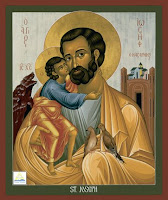
Icon of St. Joseph found here.

March 17, 2009

For the Feast of St. Joseph Part 1

Ok, ok, so it IS St. Patrick's day, so shouldn't I write on him? Well, I decided to write on St. Joseph instead, whose feast is coming up on the 19th. Not to slight the awesome of St. Patrick. And it's not just because I am Sicilian and therefore biased (though that might play some small role. I was inspired by Julian's post on the online dating scene. How, you ask, was I inspired to write about St. Joseph by a post on dating? Well, St. Joseph is not only the patron of the Church, workers, fathers, and of those departing life, but he is also one patron (along with St. Anthony of Padua and St. Agatha--I think) of those seeking to find their husband or wife. Yep, St. Joseph is one of many saints whose intercession we can invoke to help us find a holy husband. Let me tell you a little bit more about him to share with you my appreciation for this wonderful saint.

There is of course, very little about Joseph in the Scriptures. There is mention of him in Matthew 1 when the Angel tells him not to be afraid to take Mary as his wife. In Matthew 2 Joseph heeds the Angel again when he takes the Holy Family into Egypt to escape Herod. He's mentioned in Luke 2 at the Nativity. We know Joseph was a carpenter and taught the young Jesus this trade. Some traditions recount that Joseph was much older than Mary, and he is often depicted in art as an aging man. I however, like the tradition that recounts Joseph as a young, robust, brave, and beautiful man, who took a vow of celibacy with the Blessed Virgin out love of God and love of her blessed purity.

St. Joseph had an amazing privilege of guarding the family at Nazareth. What an awesome and almost unfathomable thing to be the human father to the young Jesus! It was Joseph who taught Jesus how to live in the world. It was Joseph who was the Holy Spouse of the Blessed Virgin. He is the model husband--the kind of man each of us longs for. Let us then pray to Joseph, asking him to intercede for us, to watch over our future husbands (or for those who are married-our husbands), and to keep our hearts as pure as his own. The next post will continue this meditation! In the meantime, St. Joseph-Pray for us!

March 13, 2009

Christian Unity


This past year, God has really placed in my heart a desire to pray for and to help foster greater Christian unity. I have been mulling over this passage from John 17 (verses 18-24) for months:
As thou hast sent me into the world, I also have sent them into the world. And for them do I sanctify myself, that they also may be sanctified in truth. And not for them only do I pray, but for them also who through their word shall believe in me; that they all may be one, as thou, Father, in me, and I in thee; that they also may be one in us; that the world may believe that thou hast sent me. And the glory which thou hast given me, I have given to them; that they may be one, as we also are one: I in them, and thou in me; that they may be made perfect in one: and the world may know that thou hast sent me, and hast loved them, as thou hast also loved me. Father, I will that where I am, they also whom thou hast given me may be with me; that they may see my glory which thou hast given me, because thou hast loved me before the creation of the world.

I love this part of John 17, but I'd recommend meditating on the whole chapter. What a magnificent prayer of Our Lord to be prayed right before His Passion! Almost as if He just saw the whole history of Christianity right before His very eyes! Christ prays for us to be one--so that the world may know who He is. What a scandal it is for us to squabble amongst ourselves, and yet real divisions, deep wounds divide His followers. But how are we to show others who Christ is if we cannot even agree among ourselves? Where do we begin to heal this very real wounds that fracture His sacred, mystical body and separate us from each other?

Recently the Pope came out with a statement on the priority for Christian unity. He writes that unity is essential for leading the world to God. Let me just quote his most beautiful and eloquent words:
The real problem at this moment of our history is that God is disappearing from the human horizon, and, with the dimming of the light which comes from God, humanity is losing its bearings, with increasingly evident destructive effects. Leading men and women to God, to the God who speaks in the Bible: this is the supreme and fundamental priority of the Church and of the Successor of Peter at the present time. A logical consequence of this is that we must have at heart the unity of all believers. Their disunity, their disagreement among themselves, calls into question the credibility of their talk of God. Hence the effort to promote a common witness by Christians to their faith -- ecumenism -- is part of the supreme priority. Added to this is the need for all those who believe in God to join in seeking peace, to attempt to draw closer to one another, and to journey together, even with their differing images of God, towards the source of Light -- this is interreligious dialogue. Whoever proclaims that God is Love "to the end" has to bear witness to love: in loving devotion to the suffering, in the rejection of hatred and enmity -- this is the social dimension of the Christian faith, of which I spoke in the Encyclical Deus Caritas Est.

Let us reflect this Easter on the priority of Christian unity, for it was one of the last and most fervent prayers of Our Lord on His way to Calvary...

February 25, 2009

The Reality of Sin

Here’s a great piece by the Colleen Campbell, author of The New Faithful: Why Young Adults Are Embracing Christian Orthodoxy and Fellow at EPPC:
G. K. Chesterton once quipped that the doctrine of original sin "is the only part of Christian theology which really can be proved" because even the most confirmed skeptic "can see it in the street."

Obvious as the reality of sin may be on our streets today, many American Catholics have heard precious little about this politically incorrect topic in recent decades. Although intense interest in indulgences is not a trend I have observed among young Catholics I profiled in my book or most Catholics of any age, I do see a connection between the renewed emphasis on indulgences and a growing hunger among Catholics for deeper understanding of the mysteries of sin, grace and repentance.
…There is a sense among these young Catholics, and among those older Catholics who return to a more intentional practice of their faith, that the do-it-yourself, take-it-easy spirituality so popular today is a dead end. They believe in the reality of sin and they want salvation.

These "reverts," as they often call themselves, also want the Church. The distinctiveness of Catholic doctrine and devotions does not repel them; it attracts them. For individualistic Americans accustomed to hearing that salvation is a private matter with nothing in particular to do with the larger Body of Christ, the idea that one believer's acts of devotion, penance and alms-giving could alleviate the suffering of another believer awaiting full union with God in the afterlife is radical, even if it is centuries old. And the requirement that comes with any plenary indulgence -- of "complete detachment" from even small sins -- is a bracing reminder that the journey toward intimacy with God entails profound personal transformation, not merely the rattling off of the right prayers.
Related Posts with Thumbnails