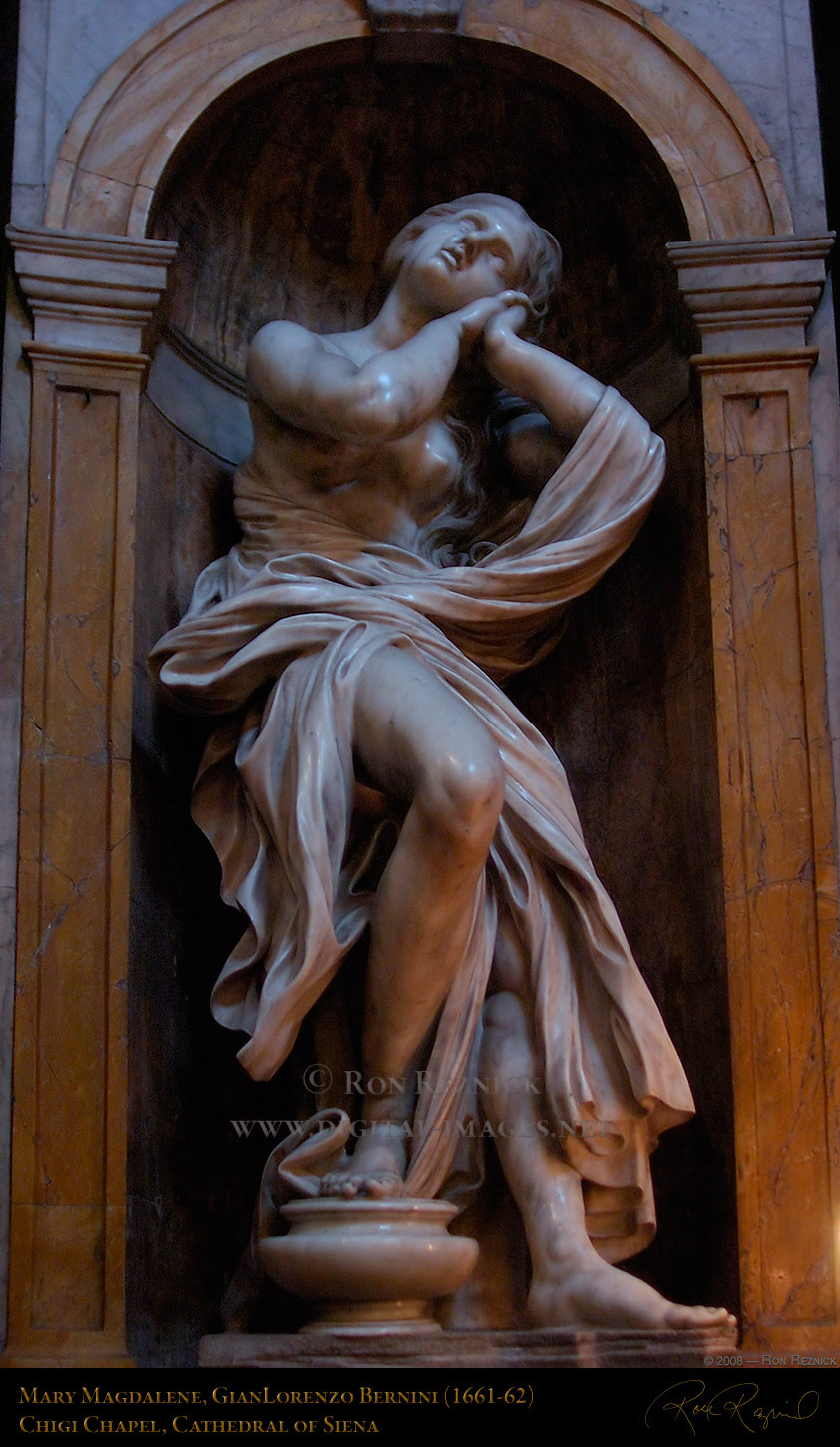
Happy Feast of Mary Magdalene. May she continue to bless us sisters, our readers, and our families!
Photo from the cover of this month's Magnificat. Found here.

Of Love’s discrete occasions, we
observe sufficient catalogue,
a likely-sounding lexicon
pronounced so as to implicate
a wealth of difference, where reclines
instead a common element,
itself quite like those elements
partaken at the table served
by Jesus on the night he was
betrayed—like those in that the bread
was breakable, the wine was red
and wet, and met the tongue with bright,
intoxicating sweetness, quite
like ... wine. None of what I write arrives
to compromise that sacrament,
the mystery of spirit graved
in what is commonplace and plain—
the broken, brittle crust, the cup.
Quite otherwise, I choose instead
to bear again the news that each,
each was still itself, substantial
in the simplest sense. By now, you
will have learned of Magdalen, a name
recalled for having won a touch
of favor from the one we call
the son of man, and what you’ve heard
is true enough. I met him first
as, mute, he scribbled in the dust
to shame some village hypocrites
toward leaving me unbloodied,
if ill-disposed to taking up
again a prior circumstance.
I met him in the house of one
who was a Pharisee and not
prepared to suffer quietly
my handling of the master’s feet.
Much later, in the garden when,
having died and risen, he spoke
as to a maid and asked me why
I wept. When, at any meeting
with the Christ, was I not weeping?
For what? I only speculate
—brief inability to speak,
a weak and giddy troubling near
the throat, a wash of gratitude.
And early on, I think, some slight
abiding sense of shame, a sop
I have inferred more recently
to do without. Lush poverty!
I think that this is what I’m called
to say, this mild exhortation
that one should still abide all love’s
embarrassments, and so resist
the new temptation—dangerous,
inexpedient mask—of shame.
And, well, perhaps one other thing:
I have received some little bit
about the glib divisions which
so lately have occurred to you
as right, as necessary, fit
That the body is something less
than honorable, say, in its
... appetites? That the spirit is
something pure, and—if all goes well—
potentially unencumbered
by the body’s bawdy tastes.
This disposition, then, has led
to a banal and pious lack
of charity, and, worse, has led
more than a few to attempt some
soul-preserving severance—harsh
mortifications, manglings, all
manner of ritual excision
lately undertaken to prevent
the body’s claim upon the heart,
or mind, or (blasphemy!) spirit—
whatever name you fix upon
the supposéd bodiless.
I fear that you presume—dissecting
the person unto something less
complex. I think that you forget
you are not Greek. I think that you
forget the very issue which
induced the Christ to take on flesh.
All loves are bodily, require
that the lips part, and press their trace
of secrecy upon the one
beloved—the one, or many, endless
array whose aspects turn to face
the one who calls, the one whose choice
it was one day to lift my own
bruised body from the dust, where, it seems
to me, I must have met my death,
thereafter, this subsequent life
and late disinclination toward
simple reductions in the name
of Jesus, whose image I work
daily to retain. I have kissed
his feet. I have looked long
into the trouble of his face,
and met, in that intersection,
the sacred place—where body
and spirit both abide, both yield,
in mutual obsession. Yes,
if you’ll recall your Hebrew word.
just long enough to glimpse in its
dense figure power to produce
you’ll see as well the damage Greek
has wrought upon your tongue, stolen
from your sense of what is holy,
wholly good, fully animal—
the body which he now prepares.


Saint Mary Magdalene,
woman of many sins, who by conversion
became the beloved of Jesus,
thank you for your witness
that Jesus forgives
through the miracle of love.
You, who already possess eternal happiness
in His glorious presence,
please intercede for me, so that some day
I may share in the same everlasting joy. Amen.
Our Father.
Hail Mary.
Glory Be.

Saint Mary Magdalene,
woman of many sins, who by conversion
became the beloved of Jesus,
thank you for your witness
that Jesus forgives
through the miracle of love.
You, who already possess eternal happiness
in His glorious presence,
please intercede for me, so that some day
I may share in the same everlasting joy. Amen.
Our Father.
Hail Mary.
Glory Be.

 by Adrienne von Spyer
Saint Mary Magdalene,
woman of many sins, who by conversion
became the beloved of Jesus,
thank you for your witness
that Jesus forgives
through the miracle of love.
You, who already possess eternal happiness
in His glorious presence,
please intercede for me, so that some day
I may share in the same everlasting joy. Amen.
Our Father.
Hail Mary.
Glory Be.

Saint Mary Magdalene,
woman of many sins, who by conversion
became the beloved of Jesus,
thank you for your witness
that Jesus forgives
through the miracle of love.
You, who already possess eternal happiness
in His glorious presence,
please intercede for me, so that some day
I may share in the same everlasting joy. Amen.
Our Father.
Hail Mary.
Glory Be.

Saint Mary Magdalene,
woman of many sins, who by conversion
became the beloved of Jesus,
thank you for your witness
that Jesus forgives
through the miracle of love.
You, who already possess eternal happiness
in His glorious presence,
please intercede for me, so that some day
I may share in the same everlasting joy. Amen.
Our Father.
Hail Mary.
Glory Be.

Saint Mary Magdalene,
woman of many sins, who by conversion
became the beloved of Jesus,
thank you for your witness
that Jesus forgives
through the miracle of love.
You, who already possess eternal happiness
in His glorious presence,
please intercede for me, so that some day
I may share in the same everlasting joy. Amen.
Our Father.
Hail Mary.
Glory Be.

Saint Mary Magdalene,
woman of many sins, who by conversion
became the beloved of Jesus,
thank you for your witness
that Jesus forgives
through the miracle of love.
You, who already possess eternal happiness
in His glorious presence,
please intercede for me, so that some day
I may share in the same everlasting joy. Amen.
Our Father.
Hail Mary.
Glory Be.
 by Adrienne von Spyer
Saint Mary Magdalene,
woman of many sins, who by conversion
became the beloved of Jesus,
thank you for your witness
that Jesus forgives
through the miracle of love.
You, who already possess eternal happiness
in His glorious presence,
please intercede for me, so that some day
I may share in the same everlasting joy. Amen.
Our Father.
Hail Mary.
Glory Be.

Saint Mary Magdalene,
woman of many sins, who by conversion
became the beloved of Jesus,
thank you for your witness
that Jesus forgives
through the miracle of love.
You, who already possess eternal happiness
in His glorious presence,
please intercede for me, so that some day
I may share in the same everlasting joy. Amen.
Our Father.
Hail Mary.
Glory Be.

A letter of authentication from Bishop Rey reports that the relics were hidden at the time of the Saracen invasions and rediscovered in 1279, and have been venerated without interruption ever since...For centuries the relics were missing - disappearing from about 710 A.D. when the Saracens pillaged the South of France and the Church hid sacred objects to safeguard them. Then in 1279, they were discovered by Charles II of Anjou in a crypt of a chapel in the town of St. Maximin in a sarcophagus that did not have her name but that contained a piece of old parchment dated 710 A.D., that said, 'Here lies the body of Mary Magdalene.'
Upon discovering the bones, Charles II sealed the crypt and gathered all the Bishops for an official opening and inspection. All of the bones including the skull were found intact. The only missing bone was the lower jaw bone which was later found and identified by the Pope as the same jawbone that had been venerated, for centuries, as the jawbone of Mary Magdalene, at Saint John Lateran Church in Rome.
Saint Mary Magdalene,
woman of many sins, who by conversion
became the beloved of Jesus,
thank you for your witness
that Jesus forgives
through the miracle of love.
You, who already possess eternal happiness
in His glorious presence,
please intercede for me, so that some day
I may share in the same everlasting joy. Amen.
Our Father.
Hail Mary.
Glory Be.

When Mary Magdalene came to the tomb and did not find the Lord’s body, she thought it had been taken away and so informed the disciples. After they came and saw the tomb, they too believed what Mary had told them. The text then says: The disciples went back home, and it adds: but Mary wept and remained standing outside the tomb.
We should reflect on Mary’s attitude and the great love she felt for Christ; for though the disciples had left the tomb, she remained. She was still seeking the one she had not found, and while she sought she wept; burning with the fire of love, she longed for him who she thought had been taken away. And so it happened that the woman who stayed behind to seek Christ was the only one to see him. For perseverance is essential to any good deed, as the voice of truth tells us: Whoever perseveres to the end will be saved.
At first she sought but did not find, but when she persevered it happened that she found what she was looking for. When our desires are not satisfied, they grow stronger, and becoming stronger they take hold of their object. Holy desires likewise grow with anticipation, and if they do not grow they are not really desires. Anyone who succeeds in attaining the truth has burned with such a great love. As David says: My soul has thirsted for the living God; when shall I come and appear before the face of God? And so also in the Song of Songs the Church says: I was wounded by love; and again: My soul is melted with love.
Woman, why are you weeping? Whom do you seek? She is asked why she is sorrowing so that her desire might be strengthened; for when she mentions whom she is seeking, her love is kindled all the more ardently.
Jesus says to her: Mary. Jesus is not recognised when he calls her “woman”; so he calls her by name, as though he were saying: Recognise me as I recognise you; for I do not know you as I know others; I know you as yourself. And so Mary, once addressed by name, recognises who is speaking. She immediately calls him rabboni, that is to say, teacher, because the one whom she sought outwardly was the one who inwardly taught her to keep on searching.

 such as Growth in Holiness and Precious Blood:

St. Mary Magdalene is one of the most important female disciples of Christ, and the first to witness the resurrection. A faithful servant to Christ, and a reformed sinner, Mary Magdalene is a witness to the power of Christ's mercy.
At first she sought but did not find, but when she persevered it happened that she found what she was looking for. When our desires are not satisfied, they grow stronger, and becoming stronger they take hold of their object. Holy desires likewise grow with anticipation, and if they do not grow they are not really desires. Anyone who succeeds in attaining the truth has burned with such a great love. As David says: My soul has thirsted for the living God; when shall I come and appear before the face of God? And so also in the Song of Songs the Church says: I was wounded by love; and again: My soul is melted with love.
--Sermon by Pope St. Gregory the Great

 Posts
All Comments
Posts
All Comments